Some time after moving to United States, I remember a shirt my parents bought for me. I don't remember the specifics, like color or brand or anything like that.
What I do remember is the tag.
Made in Honduras
I felt a few different things.
In one sense, it was kind of funny. How was it that I was getting a Honduran shirt—in the United States! Sometimes when I wore it, I would feel a little sense of pride.
Still felt funny, though.
🚆🍌
A few weeks ago, I wrote pretty extensively about recent Honduran history and how some of it seems to be mixed up in the current political moment of right-wing politics and libertarian techno-fascism.
Reflecting on that piece, I've also found it kind of darkly funny how this small country most people couldn't find on a map seems to be so pivotal, particularly in the nightmare delusions of transhumanist tech bros.
And yet, I also feel this odd sense of pride. Pride about the land. The people. The endurance.
Of course those rapacious bastards would want to steal a little bit of paradise from underneath the feet of the Caribbean residents.
Honduras, among other Central American countries, has long been exploited.
The term "Banana Republic" refers to the dependence on banana crops that were harvested and exported by the United Fruit Company and Standard Fruit Company (now Dole) throughout much of the 20th century.
That industry created a network of railways within Honduras in order to move large volume of bananas from central regions toward the port of La Ceiba.
Some of the machinery that was used can still be viewed today at a small museum in El Progreso, a small town outside of San Pedro Sula.
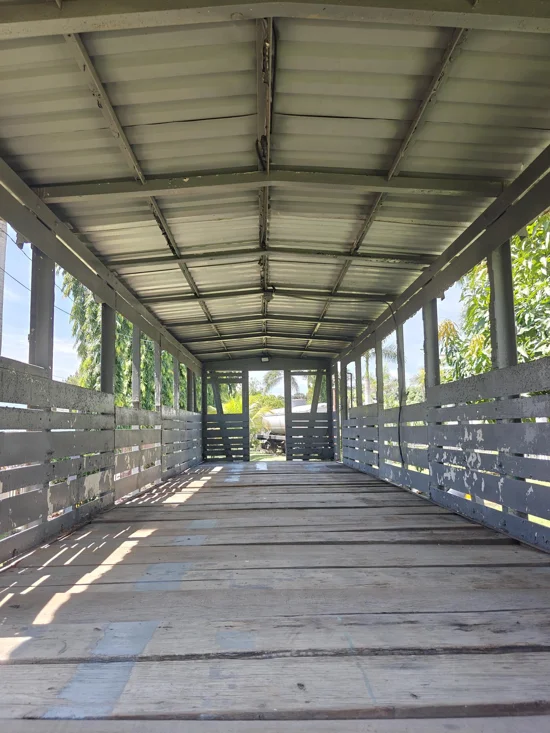


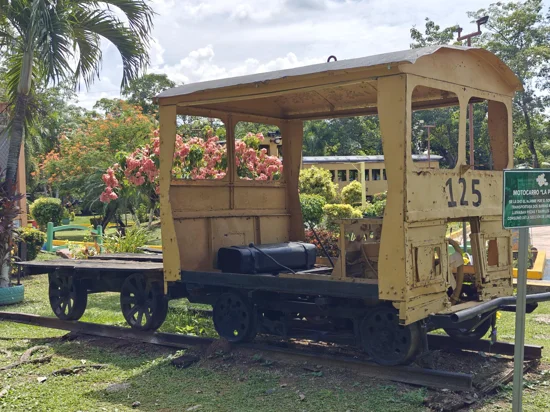
In the mid 1950s, workers staged a general strike. It began as a "wildcat" strike, meaning that it was undertaken by unionized workers without approval from leadership.
The working conditions proved so awful, that eventually over 40,000 workers went on strike, leaving over 40 million bananas per week to ripen and rot.
The United States blamed communist influence from Guatemala, but most historians believe that left-leaning views were adopted by an already repressed working class.
The strike eventually ended nearly two and a half months after it started, with workers receiving increased pay and stronger union protections.
Oblivious to all of that history, I also remember the first time I ate a banana in the United States with a sticker on it, identifying its source.
Honduras.
🧵
What I didn't quite understand as a child wearing a shirt with a tag that read "Made in Honduras" was how it tangibly represented yet another industry of rapacious exploitation.
This, of course, isn't unique to Honduras.
Much of the Global South has been colonized by various industries who take advantage of weak labor laws and cheap wages—finding it more profitable to produce and ship products to wealthy nations instead of investing in local economies.
However, this is much more complex than my biased take.
I remember talking with locals when I visited Honduras while I was in college and was becoming more aware of how truly global these industries were.
Some just shrugged. It keeps kids off the street and sniffing glue, I remember hearing.
I wondered if that was true.
As a result, I dug a little deeper and found that that the reality was far more complex.
For example, this study from 2001 titled Maquiladoras: Exploitation or Emancipation? An Overview of the Situation of Maquiladora Workers in Honduras suggests that the answer "depends on how much weight is given to the different factors... and [to] what group or standards the maquiladora workers are compared."
In other words, wages for these workers were often on par with other comparable businesses, and workers suffered equally from stress and/or other factors (mistreatment from superiors).
However, it seems that by this time, these industries had learned their lesson from the General Strike mentioned above. Worker agency to form or join unions was strictly prohibited with these textile industries.
In addition, the question remained... If transnational corporations were exporting much of the product to Northern markets at a huge markup (sometimes 50 - 100 times more than cost of production), should those corporations "be held to the same standard as Honduran restaurants, stores and companies producing products and services for an impoverished Southern market"?
Should wages, benefits, overtime, educational and child-care opportunities exceed the standard of local businesses?
There's no easy answer to that. Due to perceptions, these kinds of jobs were already in high demand, even back in the early aughts.
In fact, the number of textile workers in Honduras grew from 8,000 to approximately 100,000 in the decade of the 90s.
It is clear that transnational corporations were (and are) taking advantage of weak labor laws in order to produce products at a vastly reduced cost.
Back around the time this study was conducted, the minimum wage in Honduras was approximately $85/month.
The impoverished conditions were not caused by the transnational companies. But they weren't really helped either.
As to the question of exploitation—as the study points out—it is merely based on "how much weight is given to different factors."
📖🎥🖌
Now, shifting gears more broadly.
In the world of art and culture, there are also an embarrassment of examples where the art we consume has been created by vile human beings.
Whether books by Rowling or Gaiman, movies by Polanski or Allen, or even art by Dalí or Picasso. Cosby. Spacey. R. Kelly, Sean Combs. Michael Jackson. Et al.
There are far too many examples like this in just about any facet of the arts/entertainment industry.
And I know this seems tangential, but I think it still resonates.
How do we decide what media to consume? Does it matter on the gravity of the artist's crime? Does it matter if it seems like your money is going to a vile individual? Does it matter if the artist is dead? Does it matter if you can separate the artist from the art? Does it matter...?
🔎
These days, with a slightly more nuanced understanding of global economics, I've tried to be a little bit more mindful of where my things come from.
But to be honest, it's not something that's top of mind. I hardly look at the tags on my clothes.
Sometimes I look for "free trade" coffee, because it sounds like it might be less exploitative than alternatives. But a lot of times I don't bother.
I prefer to shop at local farmer's markets in order to support local farm workers, but I still frequent grocery stores.
I buy bananas. I don't know where they're coming from.
My appreciation of The Usual Suspects has vastly diminished over the past 3 decades, in no small part due to the Spacey/Singer double whammy.
But I don't always change the radio when Billie Jean comes on...
😫
You may already guess what I'm getting at.
It's practically impossible to avoid products or media that hasn't been compromised ethically.
There are many reasons for this, from vigilance fatigue to practical limitations you have no control over.
If you subsist on low wages, your options are severely limited. If your livelihood depends on using products or services produced by despicable corporations, what are you supposed to do? If you live in a food desert, you may not have any options of locally sourced foods.
This isn't black and white.
Again, based on your privilege, some of these decisions can be conscious and in tune with your internal ethics. But a lot of time, these decisions are not decisions at all.
You become a participator, sometimes passively, sometimes by force.
For example, you may have started using Facebook many years ago to stay in touch with family, and still use it today, sparingly if possible.
Or you may work for a company that is implementing Persona into its identity-verification workflow.
Ultimately, we may try to assess the tradeoffs by trying to ascribe practical weights to vaporous ethics, hoping to stave off any annoying cognitive dissonance.
🤖
I've written before about the abundant toll the tech industry is placing on data workers in the Global South.
I personally cannot see this any other way than a cynical abuse by tech companies, using their imperialist muscle to prey on already-struggling communities. Part of the reason I believe this is because of the lengths that they'll go to hide behind subsidiary companies, so that they can feign plausible deniability.
This doesn't even touch on whether data extraction (i.e, scraping) techniques are ethical or not. I believe this is an even murkier topic, but suffice it to say, it does play a part in how a person might feel about taking with or without consent.
Where do LLMs come from?
They come from dubiously gathered data, sifted through by data workers to absorb, review, and label.
Reported claims by data workers are far more egregious than most people realize (and perhaps pale in comparison to what Honduran maquiladoras faced).
One such data worker admitted to seeing "recordings of people being beheaded, burned alive, eaten."
“The word evil is not equal to what we saw,” he said.
Once these models are initially massaged by exploited communities, they are further fine-tuned by the tech companies.
To that last part, it is unfortunate that many individuals don't realize that these LLMs are NOT impartial. Not only do they echo pre-existing biases in source data, but they are further steered at the whims of tech leadership (notably, sycophancy is purposely tuned in order to broadly appeal to users).
On the consumer end, we are left with an abundance of products reliant on questionably sourced data.
Aside: From my view, this is hardly scratching at some of the broader, negative implications of this technology. I'm purposely excluding them from this post, as my broader point has to do with the personal relationship we have with products and media we consume.
I'm also excluding much of the purported benefits of said technology. Talking about the usefulness and actual uses of any product/technology is another topic altogether.
📜
What does all this mean, practically?
For me, it matters.
I try to be well-informed about where things come from. But I also acknowledge that I am likely to be tripped up by ideological contradictions, misinformation, or some ignorance of supply-chain dependencies.
But it still matters.
I try to make choices that align to my values.
Yet, I also recognize that this is complicated, and I have empathy for others who make different decisions than I do. Again, there are many unseen circumstances that guide our personal choices.
For example, I recently read Michael Taggart's post, "I used AI. It worked. I hated it", in which he accepts that as a cybersecurity analyst, he needs to be acquainted with these tools.
In his post, he writes:
I nevertheless recognize the societal and environmental harms posed by these tools. I want them to unexist. I even recognize the cognitive hazards to which I expose myself in their use (more on that later). I do not want to use them. And yet, I must understand them. If that damns me in your eyes, so be it.
I respect the nuance that comes with this view.
Mind you, I don't subscribe to a DIY ethical framework of moral relativism, yet I recognize that I am ill equipped to argue that my view is the correct view.
But the reason having a principled stance matters to me, however, is because the more I expand my worldview to include the plight of those who may be less privileged than me, it complements my attempts to strengthen and augment an empathetic view of the world—ultimately affecting the way I talk and act day by day.
There may come a time when LLM usage is so far removed from the source (like picking up a Made In Honduras shirt at a thrift store), that it may make a difference in my decisions.
(There would have to be a whole lot of concessions needed in order to smooth out the edges.)
In short, some of that has to do with the professed motives of current tech leaders. Some has to do with the intended uses of this technology vis a vis anthropomorphized chatbot. Some has to do with a wide array of effects that have heretofore not been properly scrutinized.
I suppose I don't have much of a conclusion here.
At most, it is a meandering reflection on the childlike question, "where do things come from" and a melancholy reckoning trying to answer it.
But also, I hope it