On Feelings
And LLM Discourse Fatigue
A couple of years ago, I remember having multiple conversations with my friend on the merits (or lack thereof) of the The Last Jedi film. Our opinions were so terse and adversarial that we invariably stepped on each other's toes. Multiple times!
Just in case it wasn't clear, I'm writing about the fatigue of constant LLM-based critiques.
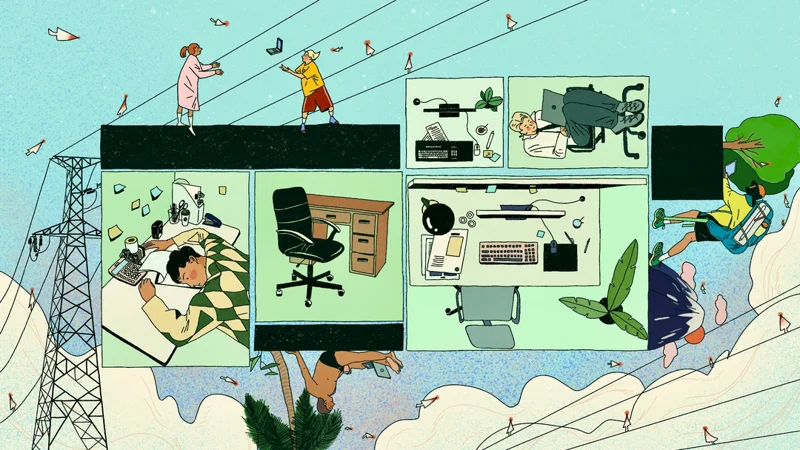 Yutong Liu & Digit / Digital Nomads Beyond the Cubicle / Licenced by CC-BY 4.0
And also to be clear, this is also one of those critiques. 😁
Empathy
In case you're a little curious as to what I'm up to these days, I've been gearing up to speak at a few Python-related conferences.
One of them, North Bay Python, will be held on April 25 - 26 (you can purchase a ticket here).
The title of my talk is An Economy of Empathy, in which I examine some of the awful history of tech and how it traces to our current landscape, and what it might look like to reckon and repair some of the damage that has been done. (Hint: It's in the title.)
But earlier today, I saw a post on Mastodon (not linking, as the post wasn't public) that expressed frustration due to the continuing onslaught of LLM-based boosterism—specifically in contrast to the critic's anger at the harms propagated by the LLM industry.
And while I largely agree that the harms are many, I started thinking about a smaller kind of empathy.
Which brings me back to my opening paragraph.
How We Say Things
Through some of the conversations with my friend, I noticed we tended to gravitate toward two extremes.
On one end, we would say things that felt innocuous. Sometimes it wasn't even the crux of our argument. But regardless, the statement was received as offensive.
On the other end, sometimes we were just being jerks, because we wanted to punctuate an argument, or it helped our egos to feel a little bit superior in the moment. Thankfully, since we're besties, we were generally able to walk back from our offense after understanding how we made each other feel.
But then there was the stuff in between.
For example, I tend to be very terse and opinionated. Sometimes I tend to say things with such absolute certainty that I come off as dismissive and unempathetic.
The thing is, with my close friends, this tends to happen more often than with acquaintances. But, due to relative comfort and proximity, there is a lot of push and pull in these interactions.
I want the listener to understand what I am saying in good faith, but the listener also wants me to try to come off a little softer, so it doesn't sound like I'm talking down to them.
This is a difficult skill to navigate, even with people you care about a lot!
Someone's Wrong On The Internet
This kind of push and pull is nearly impossible with social media.
I have seen it happen to some success within the context of long, threaded discussions. But this is certainly not the norm, and due to the nature of asynchronous communication, it can often span a very long time.
Social media is not the friendliest medium for nuance.
That's partly why I tend to blog about stuff I'm reacting to instead of coming in hot with a spicy take. (I'm also not as clever as I wish I could be, so I'd rather not take the chance at a dud.)
At least with blogging, I try to use the rhetorical situation to my advantage.
What am I trying to say?
What is the purpose of what I'm saying?
Who am I saying it to?
I read what I write. Then I re-read it.
Then I read it again, for good measure.
Rinse, repeat.
Why, you may ask? (Or maybe not. Bear with me, you're the audience I'm imagining, OK?)
Because of empathy.
Polarized
I have the unfortunate situation of having a family member who is deeply misaligned with my political persuasion, and it baffles my mind.
I just don't understand it. No matter how hard I've tried. No matter how many conversations we've had. No matter how much I try to read into certain personality quirks.
In The Great LLM Discourse, it's nearly impossible to reconcile why we see things differently with individuals we otherwise would welcome as our own.
It doesn't make sense.
I think that's what makes this discourse hard, and why we often end up stepping on each other's toes.
The Last Argument
If you've followed my writing in the past, I think all that energy is displaced.
I referenced The Last Jedi earlier because I thought it was a more neutral way to think about this. As in, any one person's experience to a film is "subjective."
Yet, that experience is also affected by external factors. Sometimes the cultural context permeates the way you feel. It could be biases you have toward studios, or directors, or actors, or race, or gender, or any of a million other things.
Your experience is also affected by internal factors. You may have expected things to be different. You may have different ideas about "purpose." You may just have different aesthetic preferences.
What I found in my discussions with my friend is that, in the end, our ideas about the film didn't even matter.
We were so intent on arguing with each other and being "right" that we even lost track of what it was that we were talking about.
Instead of arguing about whether the movie was any good, we could have used the opportunity to talk about our experiences with film, storytelling, expectations, and delight.
We could talk at large about how much or how little we think cultural influences permeated our own experience.
And so on...
LLM Again
I know that comparing that argument to The Great LLM Discourse is a false equivalence.
Critics do genuinely feel that, on the whole, the harms propagated by the tech industry are too large to ignore.
Regardless of the reasons, on the whole, our divisiveness seems to resemble the left/right political divide plaguing much of the world.
I think that's partly because the world is becoming harder to reason about, and it makes less sense than we want it to. So it's easier to fill in the gaps with some sort of reasoning that helps us sleep at night.
And we often fill in that gap with projections of contempt toward those we don't agree with. We call them deluded. Or luddite. Or as being left-behind. Or as sipping kool-aid. Or being in a cult. Or whatever helps us make sense of the world.
But going back to empathy...
Here are a few things I've learned.
- Making generalizations about others is generally bad.
- Writing in absolutes is always bad.
- Questioning someone else's ethics is questionable.
But, from time to time, you can bend those rules.
Just as my second point is a contradiction, you can generally question a billionaire's ethics with pretty good accuracy.
And you know what, billionaires make pretty good villains.
The tech industry has a track record of doing great harms way before LLMs entered the scene. With tech workers divided due to the abyss created by The Great LLM Discourse, we all have lost a bit of the agency we need to fight back.
If you're a booster/enthusiast, but are tired of seeing all the negativity, what are some of the ways you can empathize with your critic friends?
If you're a critic and are exhausted by the positivity and enthusiasm of LLM-tool users, what is there to gain by trying to convert them to your way of thinking?
Maybe there's a sliver of common ground that we could use to collectively and effectively use to loosen the noose that we're in due to the tech oligarchy.
I know that for the critics, they believe much of the grip is specifically due to the LLM-shaped industry/economy. But remember, like I said, the industry was already bad before they started putting their eggs in the AI-shaped basket.
What are some of the causes? What gives the tech monopolies so much power over their workforce and their users, where they have free reign to treat them like trash?
Well, if you're out of ideas, maybe come to North Bay Python in April. I hear there's a talk about it.