North Bay Python 2026
Recap
This past weekend, I was in Petaluma, CA for North Bay Python, where I delivered a talk, met up with old and new friends, and sat and ate lunch next to Guido van Rossum. So I decided to write down a couple of thoughts before they vaporize into the aether.
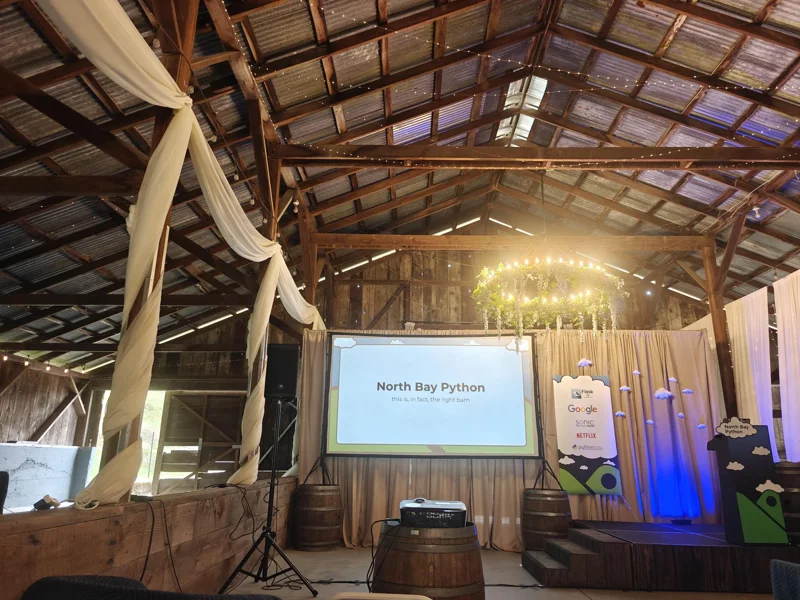
The Talk
I'm not going to summarize the content of the talk, as I've provided that elsewhere, or you could always catch the video.
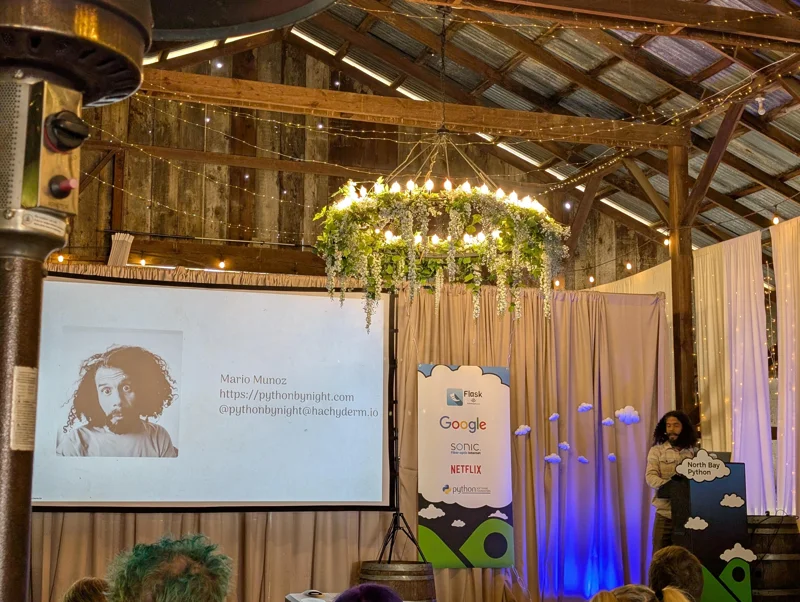
But I do want to reflect on a couple of things.
First of all, the preparation.
When I submitted to the CFP, I almost immediately regretted it, though not because I didn't want to give the talk.
But mostly because I knew it would mean having to be immersed in a very dark topic for an extended period of time. Not only immersed, but actively playing a game of connect-the-dots that only reveals an uglier picture as you go along.
Thankfully, a lot of this work has already been done. Much of this is covered in the recent documentary Ghost in the Machine and in more painstaking detail in Malcolm Harris' book, Palo Alto: A History of California, Capitalism, and the World.
But what was also startling is that there is an embarrassing amount of information on this topic—yet it stays buried and hidden away.
Out of sight. Out of mind.
I suppose this is not unique to this subject. It seems like we humans are notoriously bad at ignoring history, even if it is recent.
One thing I wanted to make very obvious for my talk, though, is that it relied very heavily on voices outside of my own. I am continually in awe of, and inspired by many individuals that try to look critically at the moment we are in, both within and outside the technological paradigm—and the wisdom that we have access to from different sources.
No matter what your disposition is, or what your thoughts are about our time and place in this technological landscape, it is so important to ensure your understanding is grounded on a diverse and authoritative set of sources. Opinions will only get us so far...
Unlike many of my previous talks, I more or less finished writing it weeks ahead of time. I ended up cutting, cutting, and cutting some more. In the end, it made for a better talk.
But I missed a bunch of things, including Noah Hawley's article in the Atlantic, What I Learned About Billionaires at Jeff Bezos’s Private Retreat, which illustrates a billionaires' complete disregard to accountability, and their disregard for others.
I missed mentioning Palantir's absurd manifesto, fitting pretty well within the supervillain template of most of these oligarchs.
And then there's yesterday's repulsive reporting at Coda Story, “All my fundees have blue eyes.” Epstein and the tech world’s dark ideology.
In my talk, I made mention of the Epstein class. His connection with academics and technologists is no secret—but the reporting above is just as bad and depraved as one can imagine.
What I ultimately wanted was to communicate that no matter how grotesque the views of these billionaires are, we have an effective counter, which is empathy.
I always get nervous as my talks begin. It usually takes a couple of minutes for my nerves to settle. However, for most of my talk, I could definitely feel urgency throughout my body. There were a few times that I thought I might need to stop, but thankfully, I don't think it was all that noticeable to attendees.
My body didn't quite relax until maybe 45 minutes after I was done.
I said this to folks at the conference but I want to reiterate this here.
The talk was successful because the audience, in equal measure, was engaged and responsive (a true gift to any speaker). I tend to think this is the norm at North Bay Python. And yes, I definitely think you should try to make it there next year..
Some (Other) Talks
I wasn't quite sure how my talk would fit within the context of the rest of the program. But the program committee nailed it!
From examining decades-old wisdom, to talking through some tangible, actionable items, I believe the underlying theme was the importance of people in the process.
These are a few of the talks that I thought fit well within the context of my theme.
What is Correct? and is that even the right question any more? by Christopher Neugebauer
Christopher's talk begins by examining what computer programs are to begin with. It does so primarily by focusing on Peter Naur's 1984 presentation, "Programs as Theory Building", examining programs not merely as code artifacts, but as theories of the manner in which problems are solved by program execution.
This view favors modification (as opposed to creating new code) as essential to building programs, either by adding (accretion) or revision (altering existing models). The latter creates code that's easier to reason about, while the former increases complexity.
Code as theory emphasizes understanding on the part of the programmer and developing a strong mental model, which then facilitates revision, as well as the ability to respond when things go wrong.
But how does this all correlate with the concept of "good" or "correct" in software? I'll leave that question open here, and I highly recommend watching the video.
Crisis (Technical) Communication by Margaret Fero
Margaret's talk on crisis communication focused on how certain essential knowledge can be shared in service of others who may not be as technically savvy.
Something as "simple" as talking about communication platforms (like Signal and other distributed social media) may actually save lives, especially now in our current political climate.
Technical people often take for granted their own skills and knowledge that could, in the right context, provide new users with help and assistance.
But sharing skills requires being welcoming and respectful of others, as exemplified by a document such as the PSF's Code of Conduct.
Even if it's helping one person with one skill, that can be a tangible form of resisting the dark patterns so typically used by tech companies which, in some cases, can lead to deadly consequences for individuals.
The Ironies of Automation in the "Age of AI" by amanda casari
Goodness, this was a great talk by amanda! She definitely downplayed it when I mentioned that I was looking forward to it prior to her delivery. But the breadth of her knowledge and her ease in communicating really stood out.
She began with a very clear, precise, and surgical definition of the subject matter, which I generally find missing in most discussions about "AI".
For instance, she referenced "The Data Science Hierarchy of Needs", illustrating the three tiers of Data, Software, and Models/Weights.
Within this context, she also talked about "agents"—in terms of automation and autonomy and the types of machine interactions that are now happening broadly.
And then she provided the backdrop of her talk from a 1983 paper titled "The Ironies of Automation" that states that "the more advanced a control system is, so the more crucial may be the contribution of the human operator."
I'm not going to attempt to summarize the adept way in which she deftly navigates and summarizes the paper, inserting the conversation squarely into our current practices within tech. But I encourage you to give the video a watch and pause as needed to reflect!
Near the end of the talk, she emphasized the need to build processes that operate at human speed, instead of attempting to accelerate people to make critical decisions at "machine speed."
This is something I want to keep in mind, both professionally and personally. Friction is not always bad. It can even be good, actually! And in a way, it also has me pondering taking things slow, in general, as opposed to trying to optimize every passing second.
Running Resistance Tech on a Shoestring by Philip James
Philip talked about resistance and how you can use technology to try and change the world around you from the dominant paradigm.
What I appreciated about the talk is that it is also tangible and practical. His experience working with DevProgress, VaccinateCA, as well as his ongoing work on CivicBand is a testament to what can be done within the context of existing technical skills (and lack of funding).
He emphasized that activating people, whether through indirect action, all the way to organizing and beyond, is essential for creating change.
Technology's purpose is to serve people!
My takeaway: Having knowledge and awareness is good. But it's even better when it motivates action that has an impact on your community. I'm continually interrogating how I can be more integrated in my own community and this talk provides a good template.
The (Other) Talks
I'm unfortunately not going to elaborate on all the other talks, even though many of them were outright awesome and inspiring.
Lilinoe Harbottle spoke of her experience working with robots in MedTech, but opened her talk with an emphasis on people, which was quite effective.
Kattni talked about her experience becoming a contributor and then core developer for the BeeWare project—which again, was centered on the human element of collaboration.
Dan Lyke talked about the history of modern western square dancing—you guessed it. People.
And Deb Nicholson had an awesome, cat-centric talk full of one-liners, zingers, and overall useful bits of wisdom.
Even the "technical" talks, whether on exceptions, APIs, lamdas (curse you, Joe!) were expressive and aimed at tickling the humanity in all of us.
This conference leans heavily into its "one track" format, and it is to good effect. The talks have some padding, length-wise (as the schedule is more flexible), which makes them feel a little more fluid.
Also, the strength of the program this year meant that I was consistently engaged.
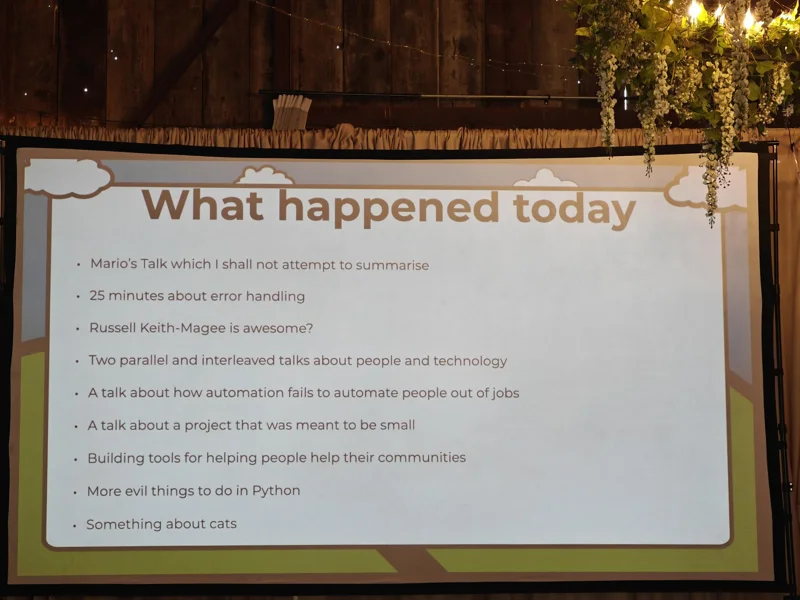
The Not Talks
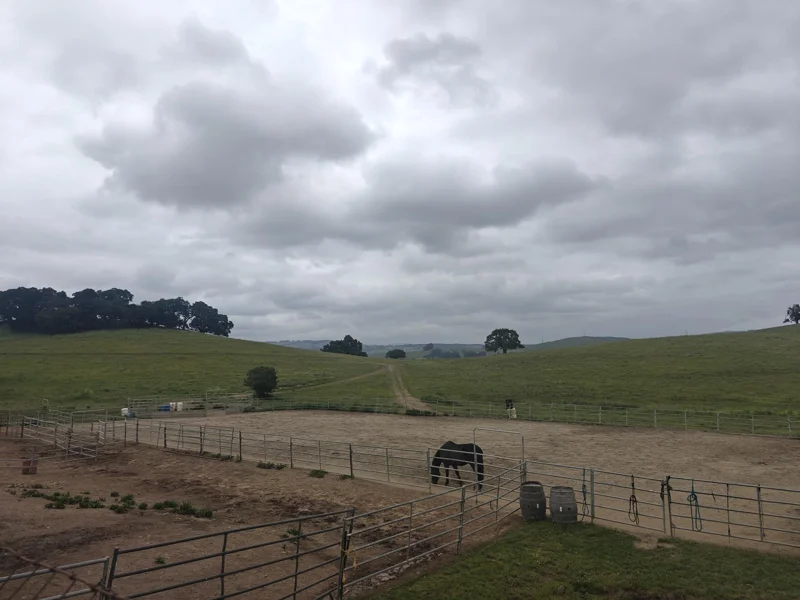
Everything else about the conference was delightful. This is my fourth time at NBPy, and there are some folks I only see at this conference, and that is always joyful. The setting has consistently been top notch. In spite of the cool weather, the ranch delivered a sense of whimsy and natural energy.
Even though the talks were indeed pretty great, as always, there is a strong sense of comradery between attendees. As I referenced earlier concerning the audience, there is no real division or hierarchy between audience and speakers.
As an example, like I mentioned in the opening, I was casually eating lunch with a group of people when Guido came after a while with his own plate of food. He joined in the conversation with ease, and he eventually echoed a similar sentiment about NBPy in general. He was just another attendee reflecting, sharing, and laughing.
So yeah. The People.
And that's it. There are a couple of other conferences coming up for me this year, with PyCon US not too far away. If I happen to see you there, do say hello! If not, go to North Bay Python next year!