Artificial Intelligence is analogous to racism.
I know, I repeated the title of this essay as my opening... for effect.
But it's not for shock value. I have reasons to back up my claim. But first, some background.
Background
In college, I graduated with an English degree because it provided me with the path of least resistance toward graduating—allowing me to take classes that were, for the most part, anywhere from tolerable to enjoyable.
In retrospect, I think I liked the idea that my grades were based mostly on the subjective opinions of my teachers, as opposed to some letter grade that was based on rigorous memorization and recall (exams). Not sure why I trusted my teachers more than my own ability, but alas, it worked out for me!
Subsequently, I believe that ambiguity (such as philosophical or artistic musings) have continued to provide me with a sense of identity in the ensuing years. (Hence, you get musings like this one.)
Towards the end of my studies, I took a seminar class in contemporary literary criticism; I marveled at the wide variety of methods for examining and understanding language. Words could mean everything! They could mean nothing!
Language was powerful and powerless all at once.
And so it is within this framing that I recount this rather shameful and embarrassing aspect of my past.
Post college, I frequently used language and vernacular that was odious and irreverent. I would oftentimes throw sarcastic insults at friends, or use slurs ironically.
Partly, that's because I believed that language could mean anything. The meaning of words changed based on the context, on who said them, or how they were used. And somehow, I thought I was above it all, since I understood.
As an example, whenever I wished to express my displeasure with something, whether trivial or semi-serious, I would often say, "That's so gay."
In certain scenarios, such as when playing video games with my close friends, the phrase and other more vulgar variations escaped my mouth with reckless abandon.
Around that time, I also worked at a place where I shared an office with someone who grew to be a friend.
He also happened to be gay.
I don't know if I ever really thought about this consciously, but I became convinced that since I had a gay friend, there was no way that I could be a homophobe.
In fact, my work friend often used the phrase as well. So it was okay, really. (Or so I told myself.)
I wouldn't have thought of myself as bigoted, hateful, or antagonistic toward the queer community.
It's only through the lens of retrospect that I can see that my choice in language was part of a broader construct. I was merely participating in and perpetuating the dehumanization of a large array of persons—by adopting a language that, at the time, I felt was harmless or, at least sandboxed within my own group of friends.
I felt that it was safe as long as long as my language didn't escape containment.
What I didn't realize is how language could shape the mental models of how I see the world, and how utterly damaging it could be in determining how I perceived others.
Was I a bad person? Was I just doing what I thought best within the context of my immediate culture? Should I have known better?
Disclaimer
It wasn't easy for me to write that previous section. I'm still ashamed thinking about it. I try to balance a critique of my past self with an attempt to make sure that it still makes me seem a little sympathetic.
I don't really know the clear-cut answers to the questions I posed, but I am glad that I have the capacity for self-reflection, and the ability to say that I've changed for the better.
So why have I led with that particular story?
I get the sense that when I say something like "AI is analogous to racism", someone who uses Claude Code might think that I am calling them a racist.
My take is, if you identify with the project that is being called "Artificial Intelligence" (as I describe below), then any critique of that project is going to feel like a personal attack.
If this is you, I encourage you to pause for a moment and reflect on why it feels that way. And if you're at all curious as to what I'll say next, try to separate your identity from what I am referring to as "Artificial Intelligence" and the complex individual you happen to be.
My goal is not to hurl accusations and condemnations. If you're feeling accused or condemned, that's through your own direction.
Instead, I am questioning, examining, and advocating for a better world—and to do that, I need to interrogate a system that seems inherently designed to erase some of the beauty that's found in the edges—in the Other that we (collectively) might rather ignore, forget, annul, fear, reject, or maybe seek out and destroy.

Remember, this is just the perspective of some blogger who happens to have enough time to write some words on this subject. If I were getting paid to do this, I'd likely be more thorough with my research and more apt to provide references whenever I make bold claims.
(I've tried to do that to the best of my ability in previous posts. Forgive me if I'm more lax this time around.)
What I've noticed with much of this kind of writing is that most people come in to it with a pre-established understanding of how things work. For example, no amount of citing data center water usage statistics will convince someone that it is a genuine problem if they've already made up their mind about the environmental impact.
Also, it's very unlikely that people reading a blog on the internet are open to changing their minds about a given topic. There are very few times in our lives when we are open to reassessing our beliefs and our modes of thinking, and skimming through blog posts is likely not it.
We live in fragmented times, and I would love nothing more than to break down barriers that keep us from propping each other up against the menacing effects of the techno-political class currently in power, even when "doing something about it" seems all but futile.
Yet, in spite of all that, I still believe it is important for me to write this. It helps me formulate my own thoughts. It allows me to seek connections between several disparate threads. It might help a small community of like-minded individuals to find solace and solidarity.
And ideally, it would nudge some of us into finding an overlap in values, so as to ultimately affect the world through positive actions.
I started with a self-reflective exercise in hopes that you approach this post with a similar mindset.
Minced
This is the unfortunate section where I try to be clear about what I am referring to. Why unfortunate?
Well, the whole "AI" project is a a muddle of minced words. Hardly any definition seems fitting. It is perfect for cross-talk, because people are often arguing about many different things.
So, going forward, my reference to "Artificial Intelligence" will focus primarily on the following five pillars. I don't think "AI" would exist as it does today without any one of these. And although each can be thought of independently, they are all inextricably linked.
The Agenda: This is mostly what you hear out of the mouth of the oligarchs like Sam Altman (OpenAI) and Dario Amodei (Anthropic), as well as other various tech CEOs and Venture Capitalists. But it also comes from various public figures within the TESCREAL bundle. This agenda—plainly pointed out in books such as More, Everything, Forever by Adam Becker, or most recently, The Nerd Reich by Gil Durán—is the worst kind of speculative fiction you can imagine. This could generally be thought of as the "purpose" of "AI" through the words and actions of those who fund and oversee the companies pushing the technology.
The Promise: This is meant to encapsulate what the tech industry presents as "AI" to the general public, and how it is always just around the corner. I would say this is synonymous to marketing. It presents "AI" as the solution to almost any kind of problem, in almost any kind of domain—whether in schools, medicine, engineering, sports, social services, law enforcement, government, military, and so on. The two most prominent terms used to entice adoption are productivity and automation, and this messaging particularly resonates with executives and managers. I'll say more about this later, but one thing to keep in mind is how "the promise" is framed to different demographics, particularly how it is communicated to the working class versus executive leadership, board members, and management.
The Politics: Current tech and political ideologies go hand in hand. Deregulation allows for companies to act in their own self interest at the expense of the working class, and helps monopolies retain control. Government surveillance fits nicely within the invasive privacy-shattering norms followed by tech companies. You simply cannot have "AI" as we know it today without a complicit government and toothless regulatory systems.
The Business Model: In order for frontier models to exist, the top tech companies have colluded in openly cynical and cyclical (illegal?) business practices that put the entire world's economic structure at risk. Additionally, the business model includes everything from massive data center build outs that threaten small, local community infrastructure; harvesting massive amounts of non-consensual and privacy-laden data; introducing "AI" tooling services through subscription and/or token-based measures, which are wildly subsidized; depleting the supply of consumer-facing computer hardware; and cramming a chat-based sycophantic input interface on as many surfaces as possible in order to gain marketshare (to name a few).
The Technology: This is perhaps what some people might exclusively refer to as "AI." This includes the software and/or harnesses; the Large Language Models (LLMs), otherwise referred to as frontier models; inference; safety checks and guardrails; fine tuning and weight distribution; and the automation workflows that are made possible through reliance on non-deterministic/probabilistic input/output cycles. The technology itself is regressive. It normalizes based on statistical methods. It is a permutation of anything that falls outside of the norm, synthesizing it into a structure with systemic biases built in, some from training data and some from tuning techniques.
I submit that you can't have "the technology" without any of the other pillars I have listed here. I'll say a little more about "local models" later, and I will explain why I don't see them as particularly relevant to this discussion. My hunch is that an overwhelming majority of the technology that is actively being used is dependent on frontier models, which can only exist by relying on the other pillars I've described above.
But wait, are they pillars? Or is "AI" a house of cards built on false promises, bankrupt morals, financial malfeasance, government collusion, and faulty business practices? I suppose that's the case I'm making here, but I struggle to be proven wrong about any of that.


For the rest of this piece, when I refer to "AI" generally, I mean it in the sense that it encompasses all of these pillars (cards), unless I call it out more specifically.
Analogue
I am aware that in some ways, my title may be overstating the impact of the "AI" industry, and adversely, diminishing the audacity of racism. One of these has been around for a very short time in human history, while the other can be traced back for centuries, if not more, so the comparison may seem far-fetched.
In addition, racism already plays a part in the odious history of Silicon Valley, and as a result, is also embedded within the project of "AI." (More on this later.)
But I believe there is also value in doing more than conflating the two ideologies into one, and instead running a parallel examination.
Due to the rapid adoption of "AI" into the public sphere (specifically within the last 4-5 years), it's often difficult to understand what is happening around us without a historical precedent.
That doesn't mean that there isn't one there, though.
Racism
Here's another anecdote to segue into the topic of racism.
A story that has often been retold in my family over decades is that of my younger cousin. It happened when he was two, maybe three years old, over four decades ago. (Yikes! I'm old.)
Back then, many weekend meals involved a gathering of extended family, friends, and the occasional visitor just passing through.
This was in Honduras. These kinds of lunches were an involved affair where many women would prepare large amounts of food while the men mostly sat in chairs and conversed amongst themselves.
The children ran around the house like alley cats, and for the most part, didn't bother with the boring adults.
On this particularly hot day, we had received a visitor. The man was wearing a white, long-sleeve shirt and dressy slacks.
My cousin, a toddler at the time, broke away from the other kids and walked up to him cautiously... curiously...
After a bit of a pause, he meekly asked, "Enséñeme la pansa..."
This crudely translates to, Show me your belly.
You see, my cousin, up to this point, had never seen a Black man. He looked at his face and his hands and saw that they were dark. He wondered if it was all a ruse.
Surely, that couldn't be his actual skin color...
I've heard the story retold in so many ways, with so much color and amusement that sometimes I wonder if it is merely apocryphal.
In my later years, when I would hear the story retold, I was unsure how to feel about it.
In one sense, it was kind of funny—my cousin's innocence and ignorance as a toddler in full display. But in another sense, it was also troubling. The amusement and glee in which the story was told without a thought of how the visitor might have felt, or if his feelings even mattered at all.
Racism is not something that can clearly be defined through a simple binary definition. There is no on/off switch. It permeates into everything, including our customs, and our language.
Was my cousin being racist? Was the visitor experiencing racism? Were we perpetuating racism throughout the years as we retold this story as a funny anecdote?
Racism is an ideology. This ideology stems from faux-rationalist perspectives, ultimately forming into hierarchical dynamics based on racial/ethnic classification and categorization of the Others.
It is also a power structure that is embedded into social systems—including science, education, social services, government, and so on. The ideology couldn't survive without the systems in place that contain either remnants of discriminatory practices, or explicit implementations of modern-day racism.
Indeed, the awful and hateful history of violence and discrimination against non-White populations is devastating. And that is not something I want to minimize with the parallel comparison I'm making here.
Yet, as mentioned above, I believe there is much to learn when we see "AI" following in the same track, and hopefully you'll see why in the following sections.
The Agenda
The end goal of racism (if there can be such a thing) is to eradicate the classes of people that do not fit within or conform to a preconceived notion of supremacy.
This odious ideology often hides itself within euphemistic facades. In the early 20th century, it bled into academia through the auspices of the false science of eugenics (vis-à-vis statistical methods). Although it has always been a part of politics (keep in mind this is written from a United States-centric perspective, though I imagine it is similar in many countries around the world), over the past several decades, the political language around racism has (or had been) hidden behind similarly obfuscated euphemisms.
In the mid 1990s, a book titled "The Bell Curve" (R. Herrnstein and C. Murray) made the argument that differences in human intelligence could be at least partly attributed to genetics (a viewpoint largely and widely discredited by science). The authors argued that policy decisions ought to be made based on the connections between race and intelligence.
One of the co-authors, Charles Murray, graduated from Harvard and got his PhD from the Massachusetts Institute of Technology (MIT). His formalized education provided enough political cover to legitimize covert racism within political and academic circles.
Racism was, of course, already deeply embedded in government and education, but finding the language to covertly legitimize the ideology became central in how racists have framed their arguments going forward.
Despite repeated criticism of the book, Murray maintained his status as a political scientist, writing numerous pieces for outlets such as The New York Times, The Wall Street Journal, National Review, and The Washington Post, and as such, remained an influential figure within the Republican party.
It is not a far stretch to say that "AI" (as defined above) has followed a similar and accelerated embedding into our political systems.
I won't bother with with recounting the genesis of the term "Artificial Intelligence", but it's no secret that much of the foundation and imagination of "AI" comes from a similar class of racist faux-intellectuals.
This history is well documented in the film Ghost In The Machine, which I have also recapped on my blog.
I'll take a small aside here to reiterate that racism within the project of "AI" is also easily traceable. The two are intertwined, and I've also made that case elsewhere. But my larger point here is that there is also something distinct about "AI" which disambiguates it from the historicity of racism as we know it (which I will get to below).
So, as I was stating before, the language that is being used by the progenitors of this nascent ideology is equally awash with bogus claims about who is worthy of power (the "high-IQ" types), the nature of Language itself, the definition of "intelligence", and the promise of some Jetsons-like utopian future.

Over a century ago, eugenics was introduced by Francis Galton, half-cousin to Charles Darwin. He applied the ideas of natural selection to humans and posited that race/ethnicity and heredity had an effect on intellect.
In the world of statistics, he is also known as the inventor of the fundamental ideas of regression and correlation. These are both ways of measuring the degree to which one variable predicts another.
(Incidentally, he popularized the idea that human intelligence follows a normal distribution, or bell curve, later influencing Murray. You should be able to see where this is going.)
Galton himself had the fortune of having credibility built in by virtue of his status as a rich, White man. His scientific and mathematical contributions have continued to be used and leveraged by other academics, in spite of the flawed premise that they are built on (namely, that regression/correlation is useful for predicting human behavior).
Similarly, the "AI" ideology has been shaped and legitimized by these pseudo-intellectuals who happen to benefit from being rich, White men, adjacent to peers in academia and government, and just as equally nihilistic and self-serving.
It's been over two years since the TESCREAL bundle was introduced into the nomenclature, but these men (it's always men) have long been producing volumes of ideology with a vision of the future that falls outside the sphere of what most scientists, social scientists, academics, or historians might agree on.
These men are not prophets. They are not smarter or more intelligent as they would like for you to believe.
Again, I don't need to rehash their words and their deeds. This is well-documented in many places (again, I highly recommend Palo Alto, by Malcom Harris, More, Everything, Forever by A. Becker and The Nerd Reich by G. Durán).
My summation of what these individuals want is a world devoid of Others. Whereas racists might see Others as monstrous, "AI" billionaires see them as abstractions. They are standard deviations. Statistical noise. Abstract numbers. They... or rather, we are no more valuable than numbers on a balance sheet.
Earlier this year, Noah Hawley wrote an article for The Atlantic where he describes his experience at one of Jeff Bezos' private retreats. The log line for that essay reads, "For the richest men on Earth, everything is free and nothing matters."
Hawley compares Bezos' demeanor to the fictional character of Daniel Plainview, from the Paul Thomas Anderson movie There Will Be Blood.
The Jeff Bezos of 2018 acted as if he still believed that people’s impression of him mattered, that his financial and social value could be affected by negative publicity. He still believed that his actions had consequences. He had not yet freed himself—the way Daniel Plainview freed himself—from the rules of men.
These small men have amassed so much wealth that they no longer fear consequences for their actions. They have become devoid of empathy and incapable of self-reflection.
Hawley retells the experience of his one interaction with Bezos. During the trip, Hawley's wife had broken her wrist. Hawley wished to connect with Bezos on a human level, so he recounted his wife's misfortune and the professionalism of Bezos' team in handling it.
But when I told him what had happened, Bezos looked horrified. He did not say “I’m so sorry.” He did not say “Do you need anything?” Instead, he made a face, and in an instant, an aide came and whisked him away. When presented with the opportunity for empathy, even performative empathy, he chose escape.
Wherein racism is often exemplified through contempt, aggression, and sometimes violence, the ideology of "AI" sees humans through indifference, detachment, and apathy.
To the billionaires, "AI" is a way to control information by harvesting data and regurgitating "truthy" output. In the end, all they seem to care about is their own survival and perpetuity.
No matter the cost.
Incidentally, at the end of There Will Be Blood, Daniel Plainview beats a man to death. Without guilt or remorse, he exclaims, "I'm finished."
The Promise
Near the end of Galton's life, he lamented that the public had not fully embraced eugenic ideology. In his final lecture, which you can read for yourself, he envisioned a future where the public would be persuaded.
When the desired fullness of information shall have been acquired, then, and not till then, will be the fit moment to proclaim a 'Jehad,' or Holy War against customs and prejudices that impair the physical and moral qualities of our race.
This very same rhetoric oozes out of modern day racists, with similar vile and venom.
Throughout history, specifically during turbulent times of deep austerity, racist loudmouths beg for a return to the way things were. They see their so-called supremacy threatened by the Others who have been allowed to infiltrate their territory.
This is the argument of weak and lazy racists who have mistaken fear and hate for intellect and foresight.
The promise of cultural hegemony and national pride is tied with a longing for financial stability and security. If the Others are purged or eliminated, they will no longer threaten the racist's way of life. This would guarantee economic abundance, personal safety, and a return to order.
Racists have historically been obsessed with productivity, efficiency, wealth, and strangely (though not surprisingly), measuring intelligence.
Ellwood Cubberley, eugenicist and early researcher at Stanford University sought to revolutionize education by emulating factory work.
Ben Maldonado writes in The Stanford Daily:
Ellwood Cubberley and his cult of efficiency transformed the way education functioned, emphasizing production, cost reduction and standardized intelligence all shaped by race and heredity.
Similarly, "AI" promises to usher in an age of prosperity, unlike anything we've ever seen before since the Industrial Revolution.
With an increase in productivity, products and services will be delivered at a faster pace. This will either drive down prices, or demand will pick up, meaning an injection of capital into the global economy.
It will usher in an age where anyone has access to information through a mere prompt. Workers will be more productive. Creatives will be more creative. Education will be more... educational. More. More. More.
But those lesser promises are propelled by the ridiculous idea that this software will somehow reach Artificial General Intelligence (AGI). Ardent belief in this reality eventually breeds two types of reactionaries—the Boosters (accelerationists who aim for deregulation) and Doomers (the "AI" safety crowd who seek to control the technology and the narrative).
But the long game... the long-term game... Naturally called Longtermism—it is a philosophy rooted in an abject failure to recognize actual, tangible harms to marginalized groups today in exchange for a bad sci-fi fantasy that sees humans inhabiting the stars in the future.
(A small aside: It's also inevitable that there are individuals in the field of "AI" that ardently believe in the promise of AGI due to their immersion in the field, as is seemingly the case with the recent resignation of Jacob Coxon from Anthropic. I'm not going to spend any time debunking the idea that AGI from LLM is possible, though I would invite you to think about where the idea comes from, how it has developed, and what are other experts (and extra points if they are non-White men) in sociology, behavioral science, linguistics, and other social sciences saying about it.)
As such, AGI fits somewhere within the realm of "ideology" and "promise." It is certainly used in public facing comments in order to drum up investment. Why else would a CEO claim that AGI has arrived via a tweet?
In any case, the messaging of the promise is scattered. Who is "AI" for? Who will benefit? How will they benefit?
If you think about those questions for a moment in reference to the individuals who are investing in this technology, you should understand that investors are not interested in bettering society. They are interested in generating value—a return on their investment. They care about market capture, user retention, and capital.
Additionally, if any company begins paying money to use "AI" in their workflow, it is not so that their workers can work less, or so that they can work on "more interesting things." Instead, they do it because they believe in the promise that in using these tools, they will generate more revenue.
In other words, companies will no longer need to pay human beings to do the work that an "AI" system is believed to accomplish. Either that, or, through their usage of "AI", the companies will be able to attract more business at a level that exceeds their costs.
The promise to the management class is one that implicitly says, you will no longer need to pay people to do a particular job.
And at the same time, the message to the working class is, your job will become easier to do or it might change, as all of your drudge work will now be done by "AI".
Those are not the same thing. A company will not pay for "AI" services and choose to continue employing workers if the net return isn't increased revenue. The unit economics would need to make sense.
Imagined if every software developer demanded that their employer purchase a fully decked out Mac Studio in order to do their job. Even that might turn out to be less than covering a few months of unsubsidized frontier-model usage.

This is why the messaging is so slippery. The marketing continues to adapt, but, as evidenced in this section, it is hard to pin down who exactly "wins." Is it the investors, the management class, the workers, the population at large?
The Politics: Let Data Reign
As I alluded to before, racism within politics is nothing new.
In the United States, it continues to divide the country in both subversive and obvious ways. It's sickening to think that if I wanted to find an example of this, I could probably do it by choosing a random news story from today.
I'm going to spare myself the disgust, in hopes that the reader will comprehend that racism within political systems is an ongoing and serious problem.
But how does "AI" parallel this notion? Is it just as embedded in politics?
Molly White tracks the political spending of tech companies over at Tech Influence Watch.
What we know from the data is that the tech industry outspends both big pharma and the oil/energy industry combined—all through shady PAC funds and other political contributions.
Much of this has its origins in cryptocurrency adjacent firms, but as of the last year, most of the major players behind these contributions are the same ones funding "AI". SuperPACs like Leading the Future and Think Big are backing pro-AI candidates, and smearing those deemed unfavorable to their interests.
Top tech CEOs from Apple, Google, Microsoft, Amazon, OpenAI, Anthropic are often seen flocking around Trump and his administration. And in one of the more startling recent revelations of how far the schmoozing has gone, Trump bafflingly urged Americans to support rapid data center growth.
...the only reason that communities throughout the U.S.A. should not want Data Centers is that they want to end up being backwards and poor.
I say bafflingly because opposing data center build outs are about the only thing Americans seem to agree on at the moment. Seven in ten Americans oppose local construction.
Now why would Trump, who knows fuck-all about the technology encourage (threaten?) communities to welcome the data centers in spite of widespread disdain?
"If they want to be successful and rich," he writes, "with far lower taxes and jobs all over the place, let Data Reign. If we kill the Golden Goose, you will only have yourselves to blame."
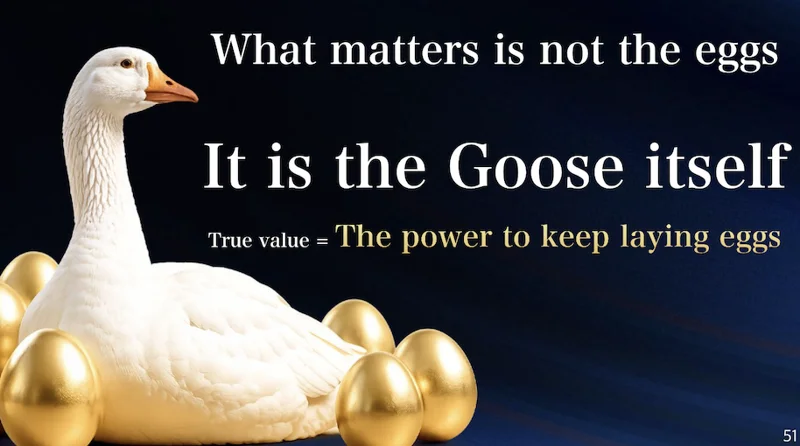
Everything he endorses seems to be at odds with what is good for ordinary, working-class Americans, and great for billionaires, grifters, and self-important nihilists.
Somehow, citizens are supposed to ignore the credible and documented environmental harms. Somehow, they're supposed to trust billionaires who have shown to have no empathy for workers; to trust a government that continually fails them.
Again, why would a decidedly fascist president endorse the building of data centers?
It's hard not to see the link. The prosperity of "AI" is directly correlated with the prosperity of fascism and oligarchy.
The Business Model
When Eli Whitney invented the cotton gin in 1794, it revolutionized the cotton industry in the United States by speeding up the process of de-seeding cotton fibers.
He intended to keep his technology proprietary, but it was quickly reverse engineered, and much of the wealth he gained from the cotton gin was lost in the subsequent years due to patent disputes.
Through his invention, Whitney had hoped that it would reduce the amount of labor needed to process cotton.
Instead, landowners saw an opportunity. Through widespread adoption of the gin, the number of slaves grew from approximately 700,000 when it was invented, to around 3.2 million by 1850.
As Whitney's business opportunity with the gin faded, he turned to producing arms for the newly formed United States Army.
While it's tempting to end here with something about rhyming history lessons, I want to walk through how some of these parallels are playing out today.
Unlike the cotton gin, "AI" wasn't invented due to the ingenuity of one person. Early experiments with Machine Learning and Natural Language Processing (NLP) led to interesting use cases in specific, controlled environments.
But as Big Data turned into "The Algorithm", and subsequently, into "AI" as we know it today, something began to change.
Since then, the downstream effects have been alarming, from data worker exploitation (which is tracked and chronicled over at the Data Worker's Inquiry), non-consensual data harvesting and brokering, companies profiting from child sexual abuse material (CSAM), and inclusion in government military contracts (to name just a few things).
But "AI" would not have a leg to stand on if it didn't have interest and bona fide usefulness, in the same way that the cotton gin fulfilled a very specific need.
There are certainly "AI" enthusiasts who have found meaningful, quality-of-life improvements, not only within the software engineering crowd, but also with some in adjacent fields (academics, scientists, mathematicians). This would be analogous to the cotton gin's adoption amongst wealthy land owners.
However, unlike the cotton gin, the business model involves an array of financial crimes that are being committed in the open. Businesses are operating on valuation (aka fake money) at a scale that is unprecedented. This allows services to be subsidized, and if (some might say when) it all comes crashing down, it will not be the CEOs and VC elites that suffer.
I'm not going to continue litigating the financial apparatus, as that is best left to economists. But what I wanted to illustrate is that, both within a racist economy and an "AI" economy, there are winners and there are losers—and I don't mean it only in the financial sense.
The cotton gin is often cited as one of the causes of the Civil War in the United States. The war wasn't about the technology at all, but the technology did lead the South to deepen its dependence on slave labor in a way that was unfathomable years prior.
Some proponents of "AI" seem to think that in a few decades, we will be living alongside a super-intelligence. Others see a shuffling of economic classes, as ensuing productivity creates a major economic boom, creating jobs that were previously unknown or unnecessary (i.e., assembling robot parts?). Some don't foresee a great change at all; perhaps there is some market disruption due to economic instability, a temporary blip in the job market, and a return to "normalcy," wherein "AI" is plugged in to more of our daily processes.
No one knows the future, and it is impossible to predict. Hoping for the least bit of disruption with the least possible harm is, to be quite honest, a sensible, or at the very least, understandable position.
But looking at "AI" not as a single "tool" or "workflow," with a business model that is only possible through the financial and political system supporting it, enabled only through the backing of the wealth class with questionable morals—it becomes extremely difficult to not imagine the worst.
The business model is the antithesis of democratization.
The Technology
As I mentioned above, this is what certain people might refer to as "AI" when they try to argue about its utility and potential. (Those who might say that "AI" is "just a tool"—there's no such thing—or that the technology is not political.)
Before I make a case as to why I've chosen not to do that, I'll briefly touch on the links between racism and technology.
Above, I referenced the cotton gin as an example of a technology that, by itself, could be considered neutral. In fact, it is quite possible that the gin could have had a positive impact on society.


Slaves could have been freed from the toil of manually extracting cotton fibers, and as a result, they would have had more time for their families and leisure activities. Right?
Right?!
The cotton gin cannot be separated from the context in which it was invented. There was an economy that was already dependent on slavery. And slavery stemmed from racist ideology, built on a promise of prosperity, backed by a political system, maintained by a profitable business model (well, profitable for the wealth class).
As a result, the invention led to an escalation of exploitation and not the reduction of it.
The cotton gin is an interesting reference because, unlike something like a bomb or a land mine, it actually does something useful. The benefit of the "tool" itself is self-evident. Whereas the purpose of a bomb or land mine is to destroy.
If we fast-forward to the current age, technology is still facilitating the exploitation of marginalized groups. Even before the advent of "AI", corporations were using Big Data and Algorithms to enact racist tactics.
However, proponents of the "technology" may object to attaching the supposedly neutral technology into criticisms about "AI" as I'm doing right now. They may see it as throwing the baby out with the bathwater.
The case I'm making now is that it is unrealistic to think of the technology in isolation.
But let's say we are talking strictly about the "technology" here, specifically the pre-trained language models built using transformer architecture, scaled up with extensive training data, usually denoted as LLMs, as well as the resulting inference.
It also involves the work of harnessing (writing software around) these systems, prompting instructions, and evaluating the results (evals). The workflows can be very basic, or eventually resemble a complex Rube Goldberg machine.
I'll leave it at that for brevity's sake (lol) and now shift to the idea of utility.
In order to talk about utility, we also have to identify a need.
With the cotton gin, the need was easily identifiable. Removing seeds from cotton fibers was a slow and tedious process. The gin had a clear, identifiable measure of success.
With LLM technology, this is a little different.
Yes, some Software Engineers have found usefulness in workflow automation, summarization, code generation, security/vulnerability research, and more.
However, unlike the cotton gin, LLM technology also has many ambiguous usage patterns with questionable effects. (The cotton gin machine could possibly be used for some malicious task, but that is highly unlikely.)
For example, LLM technology makes it extremely easy to create harmful content, including propaganda, deepfakes, CSAM, and so on.
In addition, the actual usage of LLM technology can have adverse psychological effects, particularly when the input mechanism is meant to resemble a chatbot. This article in Psychology Today even posits that children who use "AI" chatbots in a context they are unfamiliar with will never build necessary life skills. The author calls it cognitive foreclosure.
Because LLM technology has been marketed and inserted into as many surfaces as possible—education, social services, finance, front-office tools, academia, technology, government—it has been virtually impossible to study the effects of prolonged usage and how it might affect an individual, a family, or a community at large.

And the reason that the technology is being pushed into all these sectors is precisely because of the pillars I have written about above, and not to fulfill a specific need.
The technology cannot stand on its own. It must be forced.
Several proponents may point to "local models" or "ethically-sourced AI" as a panacea to the current state that we're in.
This includes Apertus, the Swiss "AI" model that claims to be free and open-source. With their General Data Protection Regulation (GDPR) compliance and promise of transparency, this is indeed a step in the right direction.
But even the developers of this model admit to its limitations when contrasted against the frontier models built by the Western "AI" labs. For example, the largest version of Apertus boasts 70 billion parameters, when even GPT-3 was already at 175 billion parameters (and modern frontier models boast over 10 trillion).
Per swissinfo.ch:
"Comparing Apertus to big American companies' AI models is like comparing a small farmer in Valais to a massive beef producer," says El Mahdi El Mhamdi, professor at the École Polytechnique of Paris.
It is impossible for Apertus to keep pace with Western AI labs:
The only way to insert changes and corrections in an AI model is to re-train it. But this is a very expensive process that only companies with large resources can afford to do frequently.
For the next round, Apertus hopes to draw from $25 million in federal funding. When you compare that to the budget of the US-based labs, this is a mere drop in the bucket. (Frontier models are rumored to cost well over $1 billion to train.)
Maybe there's a market for localized models, or ethically-sourced ones like Apertus. And maybe there are specialized use-cases where they can be deployed in safe environments, while also being cognizant and responding to the immediate effects it has on users and their communities.
But that is not the world we live in right now and that is not how "AI" is being used in the vast majority of cases.
The technology that exists today comes from an explicit worldview enacted by the ultra-wealthy who have specific goals in mind, and it is being carried out by government and businesses/corporations through greedy and thoughtless implementations.
That is the context we are living in, and that is why I don't believe that you can separate the technology from a proper discussion about "AI."
Synthesis
This is where I try to wrap things up, while at the same time sardonically referencing the very thing that LLMs do well—synthesis.
I have made the argument before, and I will make it time and time again. If you haven't lived in the margins, it's hard to understand the narrative of displacement and erasure.
As an immigrant, I have been fortunately somewhat insulated from a lot of the harsher effects of racism in the US. When I was younger, I thought I did a darn good job of "assimilating" into the culture. For example, sometimes I would consciously question if I had an accent, and I would take it as a point of pride if a native English speaker told me that they couldn't detect an accent.
I don't think this is particularly odd. I think a lot of people might prefer to fade into the background. To be less noticeable. But it's also a little sad that I didn't find comfort in my own identity as a Honduran immigrant.
I grew up and was schooled in the South (my family immigrated before I turned 7). I learned that Manifest Destiny was a good thing. My Middle School teacher occasionally quoted Rush Limbaugh. I didn't learn about the United Farm Workers until I moved to California as an adult.
In some ways, I was a victim of racism, but in others, I was racist too. And homophobic. And suspicious of poor people, for some reason.
Luckily, through solid parenting, better teachers in college, friendships, and possibly a bit of luck—I have managed to accept my failures and follow the desire to do better, to be better.
Now, as I wonder what the landscape looks like for my daughter as she grows up, I wonder what it must be like to have an information system that is diluted, synthesized, and spat out without any foundation of truth. I wonder what it's like to grow up with that.
It's not even deception. It's not hallucination. It is a "technology" that is designed to erase everything that makes us unique. Everything that makes us a little different.
As she gets older, I hope that she always knows where she can turn to when she needs someone or something to trust.
When she was younger, I remember reading her the book Antiracist Baby. The through line of that book is that an antiracist baby is not born that way, they must be brought up and taught to be antiracist.

"Babies are taught to be racist or antiracist—there is no neutrality."
I didn't (and still don't) want my daughter growing up like my cousin did—where unintentional racism was the norm. Where the thought of someone different was so unheard of, it had to be made up.
In the great scheme of things, I think I've had it better than the majority of people, those whose voices are being drowned out, whose accents are being Anglo'ed, or ultimately, whose entire race is being erased.
It feels like a foregone conclusion: I don't think it's enough to exist in the present moment expecting things to get better on their own.
Could it be that if (and after) the financial bubble pops, things will return to normal?
The most likely scenario is that the billionaires who are profiting today, as well as the enablers in government—they will escape mostly unscathed. The people who will suffer will be the ordinary folks, because it's always the ordinary folks that suffer.
Marginalized people will suffer worse.
The ideology will not collapse. The financial instrument used by the wealthy will continue to lobby government, and the same oligarchs will be there to symbolically bend the knee to whoever will be swayed by their displays of service. And the management class will continue to look for ways to exploit workers.
Perhaps "AI" will morph in name, but not in practice.
We are not at a place yet where "AI" is causing the enslavement and destruction of millions of people, as racist forces have historically done, time and time again.
But it does seem to be part of the narrative. "AI" is so dangerous it could wipe out the entire earth, they say. The people working on it are terrified, they say. Everyone could die! And yet... They just don't care enough to stop.
The "technology" will not do this on its own. But if you are nothing more than an abstract statistic, billionaires won't care if their so-called prophecy comes true due to non-deterministic, brute force recklessness. And if the result of that is massive harm, they'll have "plausible" deniability (the "AI" did it).
Why would we give them that much leeway?
Conclusion
As I conclude here, I do want to very briefly address the voice of the Purist who thinks—it is hypocritical to criticize "AI" when you [insert any of the following] (eat meat, use a cellphone, own a gun, smoke, work at such and such a company, fly in planes, voted for such and such politician, hate kittens, etc...).
You're probably right, it may be a little hypocritical.
But it's not wrong. You don't have to be vegan to oppose racism. You don't have to renege flying across the country in order to criticize racists. You don't have to quit smoking to speak out against racist policies. You don't even have to like cats to hate racism.
If you're still convinced that LLM technology itself is different than the "AI" I have described here, my opinion is that your interpretation is at odds with how the billionaires, executives, and VC funders describe "AI", as well as what they see as the ultimate endgame.
Doing so requires either a bit of apologetics for the billionaire class (i.e., they don't mean what they say; they're a little looney but they mean well; they think they are creating something bad for people, but it's good actually; they are too powerful to stop anyway; this tech is a net-positive for humanity because the billionaires are not really in control, it's science!), or it's a bit of a narrow perspective that diminishes or ignores the downstream impact (i.e., that sucks for data workers, but this saves me so much time; finding software security vulnerabilities is totally worth the displacement of communities by data centers; the cotton gin was good actually).
Perhaps there's a way to oppose the oligarchy while staying enthusiastic about "the technology." Perhaps you're not concerned that the industry is being led by so-called Rationalists that, in spite of believing that "AI" is akin to a weapon of mass destruction, they continue to build it anyway. Maybe you've found a way to keep these things separate.
I'm not saying that there aren't any interesting ways in which LLM technology is used. But outside of very rigid contexts with a high level of domain expertise, I don't see any positive usage at scale that offsets the negative externalities of unfettered adoption, under the deluded direction of Silicon Valley nihilists.
If it can be shown that LLM technology can successfully be divorced from the systems that sustain "AI" as we know it today, and the positive effects of usage can be proven at scale, I have not yet seen any compelling evidence of that.
But trying to wriggle our way out of this trolley problem is asinine, when the most prudent thing would simply be to stop the trolley.
I've mentioned why I don't believe local models, or projects like Apertus are it. These are just residue from what is actually happening in the space. Small farmers up against massive beef producers.
You can be genuinely excited by these local models, or Apertus, or open-weights (even if I am not); but hopefully you recognize that much of it has come through the toil and suffering of millions. And you should still be able to oppose "AI" as I have defined it here without compromising the comfort you might find within the constraints of your "ethical" use cases.
As for me.. I will continue to be, and continue raising my daughter to be anti-AI.
There is no neutrality.