Threading the Needle
Threading the Needle
And Contradictions
Finding common ground, especially during these polarized times, can feel difficult—like threading a needle.
In fact, I'd wager to say that in some cases (especially politically), it's unclear if we're even within the same Venn diagram as others.
Yet, as my more recent writing has shown, I'm trying to do just that, in the midst of the conversation(s) in and around the "AI" industry.
Wishy Washy
I'll admit, it doesn't come without its own fair amount of self-doubt. If I'm trying to have it both ways, how can I be certain of my very own values?
That is partly why I try to be clear about my criticisms, specific to stated goals, ambitious plans, troubling philosophies, and checkered history of current tech leaders.
In addition, I've also decided that personally, my decisions about using certain technologies need to be consistent with my value system.
I'm thankful that I am privileged enough to try this, and am sympathetic to others who do not have that privilege or opportunity.
I've tried to ween myself off of Gmail to Tuta. I've tried to transition messaging to Signal. For browsing, I depend on Vivaldi, and I've been trying this scrappy little search engine from Canada called maapl.
I initially tried PhotoPrism for photo storage, but am now giving Immich a try. I finally cancelled my Spotify subscription, and may try out Deezer for a bit. I only use Mastodon for social media.
And I rarely use GitHub these days, as I've moved my development over to Codeberg.
But guess what, none of that makes me any better than any one else.
Those are just things I do so I have less cognitive dissonance during my day to day computing.
When I use tools that are in any way tied to destructive forces, I can't help but be taken to a negative space. So I try to reduce my dependence on those tools as much as possible.
I still use Gmail here and there. My immediate family still uses WhatsApp. I still have some pictures backed up on Google's servers. I use VSCode. I have a moderately expensive Android phone.
If I stop to take stock at the end of the day, I can generally find contradictions within my choices regarding what I think is right or wrong. This has actually been a regular occurrence of mine for far longer than I've been a programmer.
Anyway, I wrote all that as a backdrop, just so you, dear reader, are informed as to where I'm coming from.
Being technically pure is near impossible these days.
And it will always be easy to catch someone in a contradiction of values. I do that to myself, all the time.
But at the very least, for myself, I find value in assessing where I stand, why I'm standing there, and where I should move to next.
Hence
That's partly why I'm writing.
I love writing. It's a magical gift.
There is an exhilaration I feel when collapsing abstract thoughts into these shapes and spaces you're looking at. And there's the hope that, somehow, within some alchemical, linguistic transfusion, you—the reader—will receive my transmission.
It will always be flawed.
What you read is informed by your own experiences. What I meant and what you understood will always be a tiny bit off.
But that is the beauty of communication. It's done with the hope that we are being understood.
And in reference to the previous section, my writing is my attempt to move—as in, to try and enter into dialogue with others, some who may agree with most of what I say, some who disagree with some of what I say, and others who mostly don't care.
I'm trying to thread that needle.
Stranger
In college, I read Albert Camus' The Stranger and was taken in by a certain existential dread (as one does). (It didn't help that I was also reading a lot of Franz Kafka, but I digress.)
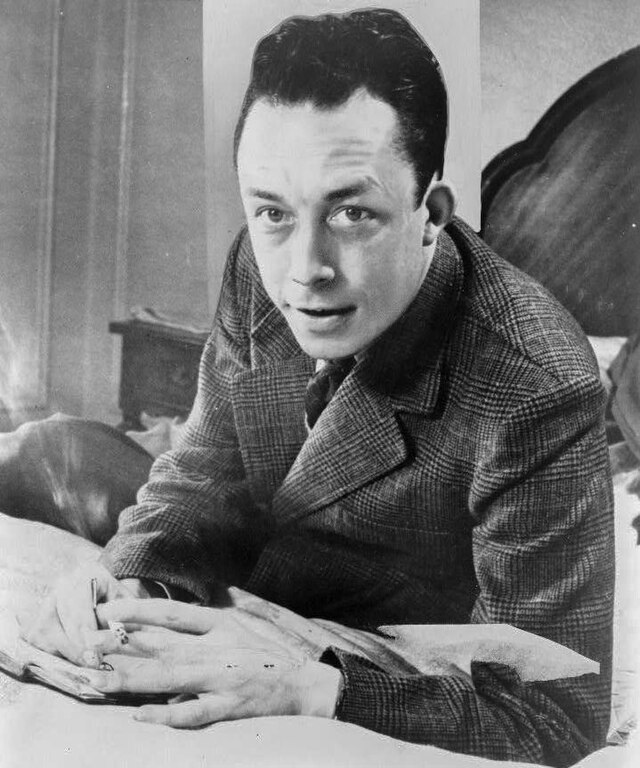 Albert Camus, Public Domain

As we studied Camus in class, I learned of his opposition to the death penalty, specifically his spectacular essay, Reflections on the Guillotine.
What I found fascinating was his clarity and crudeness in talking about the absurdity of the death penalty—equating it with unabashed revenge.
He cited its inefficacy in reducing violent crime, and turned the brutality of the act completely on its head [pun sort of intended]. He felt compelled to write about it.
I believe that the repulsive aspects of our condition, if they are inevitable, must merely be faced in silence. But when silence or tricks of language contribute to maintaining an abuse that must be reformed or a suffering that can be relieved, then there is no other solution but to speak out and show the obscenity hidden under the verbal cloak.
What I also found interesting in his essay was that, in his critique of what he would consider state-sanctioned murder, he found no logic or reason.
Additionally, he also pointed to executions sanctioned by the Catholic church and contrasted the difference. Catholics, he argued, at least had the view that a victim of execution still had a chance to repent, by virtue of believing in an immortal soul.
That was was at least a tiny bit better than supposed rationalists who were also proponents of the death penalty.
Dialogue
Now, why am I talking about this particular essay?
Believe it or not, I'm not trying trying to tie the harms of "AI" tech to the moral/ethical dilemma around capital punishment.
However, I wanted to point out how Camus—himself an Atheist, philosopher, political activist, novelist—engaged with a group that would ordinarily be outside of his wheelhouse.
In a collection of essays entitled Resistance, Rebellion and Death, there is a fragment of a talk he gave at a Domincan Monastery in the late 40s. (This fragment is titled The Unbeliever and Christians)
In his opening, he lays out a few principles.
First, he, as an outsider of the Christian faith, will not make assertions as to the obligations of being a Christian. Secondly, he will not start from the supposition that Christianity is illusory, "but merely from the fact that I could not accept it."
What I find most interesting is contained in his third principle, which I will just quote here:
I shall not try to change anything that I think or anything that you think (insofar as I can judge of it) in order to reach a reconciliation that would be agreeable to all. On the contrary, what I feel like telling you today is that the world needs real dialogue, that falsehood is just as much the opposite of dialogue as is silence, and that the only possible dialogue is the kind between people who remain what they are and speak their minds. This is tantamount to saying that the world of today needs Christians who remain Christians.
Revulsion
Camus ends his third principle by articulating his differences. But, he says, "I share with you the same revulsion from evil."
I have friends with all sorts of viewpoints.
I have friends with all sorts of contradictions.
But I'm fairly certain that all my friends have a certain revulsion from evil.
I guess that's the eye of the needle I'm trying to thread.
Falsehood is just as much the opposite of dialogue as is silence.
So, if you have more to say about this, don't be a stranger...