Slop
There was a recent discussion (a euphemism) on Mastodon about the term "slop" and how it is used. Also, I'm participating in this faux-class called "Before Meaning," in which we read through weekly assignments of literary and/or philosophical nature and then pretend to discuss intelligibly about the connected themes. (The class is run by a friend-of-a-friend entirely asynchronously, and a handful of us participate as time allows.)
How is that related, you may ask? I'm glad you asked (or didn't, I can't be sure, but I'm going to write about this anyway. In a round-about way...)
Pointers
In the world of Python, there is a concept of an object, which the official Python documentation refers to as "the ultimate base class of all other classes." [Emphasis mine].
Objects are kind of hard to define, because technically everything is an object in Pythonland.
According to the documentation, however, the ultimate objects are these "things" that, themselves are objects, but also are the basis of other objects. Things like lists, sets, tuples, dictionaries, strings, numbers, etc...
You can create new objects, but these objects cannot "contain" other Python objects. They can only point to or reference other objects.
Certain objects have properties, such as mutability or immutability (i.e., lists vs strings), but generally, they contain certain properties within the context of Python so as to be called objects.
Could you, theoretically, create a new kind of object in Pythonland? Sure, but they would need to reference (or point to) existing objects.
Certain objects can point to objects that point to objects, etc... It can sometimes seem like a Russian nested doll (also commonly referred to as "inheritance").
Definitions
Objects in Python are defined by properties that are generally unseen. These sorts of properties can, for example, create a name for the object, define how attributes of the object can be set or retrieved, and so on.
These properties are often times exploited, which can lead to surprising interactions with the code, especially if these adaptations are not adequately documented.
Circling back to the idea of objects in Python, we find that there are also certain constraints in terms of what constitutes an object.
And the kind of mental model a person makes about such things can also affect how they interact with language in general.
(Aside: I recommend Trey Hunner's post on Variables and objects in Python for a more thorough explanation of what I've been writing about here.)
To define objects in Python, you must use Python objects.
This reminds me of words in a dictionary. In order to define a word, you must use other words to define the initial word.
But where does understanding come from?
Language as Layer Cake
That's where the faux-class, "Before Meaning" comes in.
We've been discussing different aspects of how things begin to mean something, particularly through language.
In communication, many of us take for granted how amazing and miraculous it is that people can have dialogism at all.
Even though we haven't talked about this in our "class" (yet), I'll take this moment to introduce Mikhail Bakhtin, a Russian philosopher and literary critic, widely influential in the Humanities, including literary scholarship, philosophy, sociology, and so on.
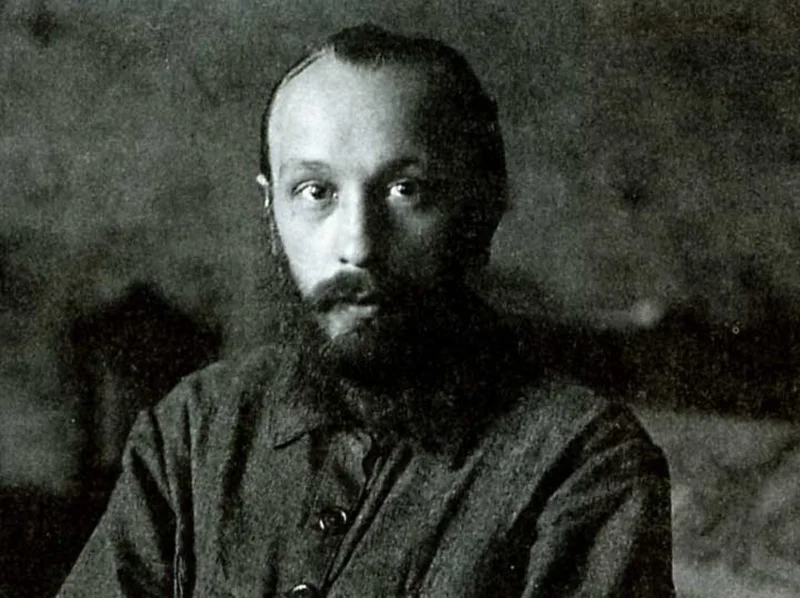
In the early/mid 20th century, he introduced the concept of heteroglossia, which, in my vulgar attempt to condense it for the sake of TLDR—is the understanding that language is composed of additional, meta "languages".
It describes a multilayered language system that includes, among other things, differing and sometimes opposing points of view, conflicting value systems, differing perspectives from the originator and the receiver.
In other words, language is extremely stratified, and is often many languages all at once.
In essence, any communication contains an enormous amount of context outside of the text or utterance itself, as well as a tension that both centralizes and destabilizes meaning.
Dialogism
Bakhtin went on to describe how, within the context of heteroglossia, individuals are able to dialogue.
Meaning is not contained in the words or symbols themselves (or the utterance). It can only be found within a greater context (as seen through the lens of heteroglossia).
Hence, the meaning of what is said/written must be in dialogue with what has been said before, and in anticipation of what may be said in response.
In other words, in any dialogue, there are many perspectives, sometimes at odds with each other, and these forces may even compete for dominance.
This means that there is no "closed meaning" for any given point of discourse—but rather, something more akin to a "living conversation"—a dialogism, if you will.
Cohesion
I started this post talking about what an object is in Python to make an illustration.
In programming, it is beneficial to contextualize your understanding of certain terms, to respect boundaries, to document processes, to build on reproducible logic, and to anticipate exceptions.
For example, by understanding the ultimate nature of base Python objects, you may be able to disentangle complex codebases.
Debugging is a type of deconstruction that will eventually lead you to a "truth" about what went wrong in your program. You can do this by walking backwards through the nested dolls of Python objects.
But in natural language, specifically in the context of dialogue, a dictionary is next to useless. No amount of defining and redefining a term will do you any good. And it is utterly impossible to deconstruct a discourse to its bare parts—because each attempt carries with it additional weight/context of its own.
I also brought up programming because the discussion on Mastodon consisted mostly of programmers—individuals who are conditioned to model their understanding in concrete ways.
But natural language is not like programming.
Slop
Which, finally, brings us back to the discussion at hand.
The free and open source office suite known as LibreOffice entered The Discourse™ by making the assertion that, while their developers are allowed to use LLMs as part of their workflow—due to their strict contribution guidelines, they "do not accept any 'slop'."
This, quite predictably, set off a heated discussion between detractors and defenders and passers-by, each with their own attempts to define and redefine the term slop.
If we follow Bakhtin's theory of heteroglossia, it is easy to see why this went nowhere and everywhere all at once.
Part of the problem in LibreOffice's declaration that they "do not accept any 'slop'" is that this statement enters the fray of an already tense discourse.
There is a past it has to deal with. There is a future it must contend with.
Some context: LibreOffice had previously announced a record number of downloads for the month of September.
And at Linux Days in early October, they even mentioned that their "Anti-AI" stance was a "feature," implying that this stance had a big impact on its recent success.
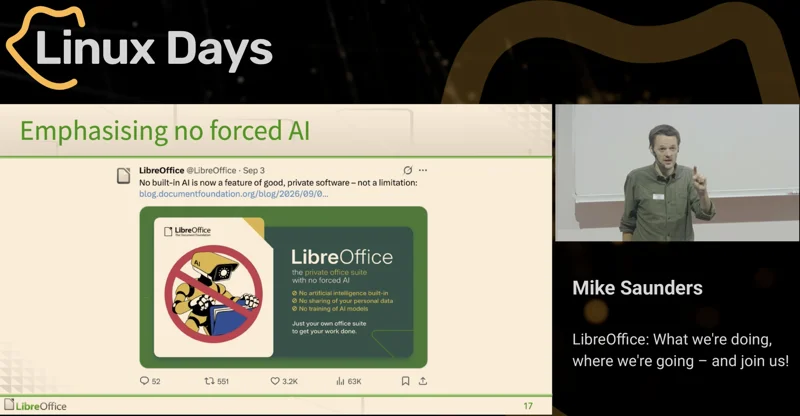
Now, to be fair, in that same talk, they did not claim to be "anti-AI", inasmuch as they allow users to use the app however they see fit, integrating with LLMs at their own discretion.
But the posturing of LibreOffice as having an "anti-AI" feature is part of why the discussion is fraught.
If no built-in "AI" is a feature of their own product, what does that communicate about their views on the technology and its effects on software development—and by extension, on the world at large?
As critique mounted, LibreOffice tried to curtail the discussion by pointing to their strict guidelines, and alongside this, sought to dismiss their association with the word "slop."
But, who gets to define the term slop?
Is it "spilled or splashed liquid"? Is it "soft mud or slush"? Is it "unappetizing watery food or soup"? (American Heritage Dictionary)
Is it stochastic text that is generated through statistical methods as a result of user input?
The problem is that the context will change the shape of what it means, both from the utterance (the individual who said/wrote it) to the receptor (the individual who receives it).
At some point, the connotations (the layer cake of language, aka heteroglossia) are extremely fraught, and the utterance itself becomes powerful—which is likely why differing sides try so hard to control the meaning.
Say What You Mean?
It's impossible to say what you mean.
There are too many uncontrolled forces that will inevitably disrupt your intention at the point of entering a discourse. This is not really your fault. It's a feature of language.
If you're entering a tense space within discourse, it's important to recognize that there are aspects that are far beyond your control. It may be helpful to try and reduce the potential for misunderstanding by falling back to terms that are less prone to re-contextualization.
You don't own the language, and you're sure as hell not going to get very far trying to convince other people that your way is the right way to understand a specific concept.
Perhaps it may have helped if LibreOffice invoked a more neutral tone when facing down the criticism for allowing LLM contributions into their codebase.
They could have written—We recognize LLM output is stochastic in nature, but we have high confidence in our ability to detect wrong or harmful output.
Okay, fine, that may not have insulated them from critiques by individuals that feel strongly about the inclusion of stochastic output into open source software to begin with—but again, layers!
That's because the context of even allowing generated text that is distributed by powerful technofascist companies is itself a discourse that permeates even the most seemingly banal proclamations.
This is why Bakhtin might say that dialogue is best understood as a "living conversation."
Language is already fragmented by nature.
One of the effect of not recognizing its power with any sort of responsibility is the erosion of trust and the splintering of our communities.
I believe it is, at best, extremely shortsighted (and at worst, willfully provocative) to enter a discourse without at least recognizing the contexts that hold it together—and that sometimes the context is made up of opposing views and values.
Synthesis
I haven't always been the best at recognizing the power of language, and I'm sure I'll fail again.
However, I don't think it is necessary to adapt your views because of language.
In other words, I have a strictly repulsive view of the current flood of "AI" technology and the way that it is wholesale being inserted into almost every facet of our lives. I distinctly loathe the leaders of the major tech firms and their stated goals.
I think any output from LLM is stochastic in nature.
stochastic: adj - involving chance or probability
But engaging in this conversation is not to nitpick about terms that come and go and lead to nowhere.
Instead, it is a conversation about history and power dynamics. It is a conversation about erasure and exploitation. It includes delusions of grandeur and lack of accountability. It involves financial malfeasance. It deals with lack of consent, intrusion of privacy, and destruction of social norms.
And that's just on the surface.
If you believe that you can enter dialogue without at least acknowledging the contextual overflow of these and other items and without any anticipation of what it means for our future—then I'm unsure if you really mean what you say.
Nick, do I get extra credit for invoking Bakhtin?