Finding the Rhythm
In Which I Don't Even Mention AI
Back in my twenties, I volunteered to "run sound" for a friend's overly ambitious attempt at shooting a movie. I got the honor of running around with a boom mic around various places in Maryland and remember having great fun doing it.
The movie didn't turn out that great. (It was bad.)
The experience was pure delight, though, especially since I got to run around with a great group of people.
But even though we had a friendly and good-natured team, I don't think the vision was just right, and most of us were novices anyway. Maybe if we would've tried again, it would've turned out better? Who knows...
Unfortunately, that turned out to be my first and last foray into movie making.
It's all good, man
Late last year, I rewatched the complete TV series of Better Call Saul.
The series is incredible on all accounts. The acting. The directing. Photography. Sound. Score. Script. Costume. Set design. And so on... It's perhaps one of my favorite series of all time.
(Complete absurdity that the show never won an Emmy.)

(Photo by Michele K. Short/AMC/Sony Pictur - © 2017 AMC Network Entertainment LLC. and Sony Pictures Television Inc. All Rights Reserved.)
While I think Breaking Bad is an excellent show, I've had many conversations with a friend of mine as to why I think Better Call Saul is even better.
I know this is debatable, and much of this amounts to taste, but even so, there's little doubt about the show's greatness.
One of my arguments in favor of the show is how cohesive it looks and feels in terms of story, character development, and visual congruency.
It feels like every frame is relevant. Every word of dialogue is necessary. Each scene is carefully crafted.
I suspected that much of this was due to creators Vince Gilligan and Peter Gould having more experience and time to work on the tone of the series, and as such, hone the story into a tight and satisfying narrative arc, as compared to their previous work.
Breaking Bad always felt like it was finding its footing in the first season. The tone was a little unsteady. But Better Call Saul seemed to know exactly what it was doing from the get go.
From Many, One
More recently, I finished watching Pluribus (Gilligan's latest) which I also have enjoyed greatly.
To an even finer degree, the show feels extremely cohesive and singular. Extremely deliberate in its execution.
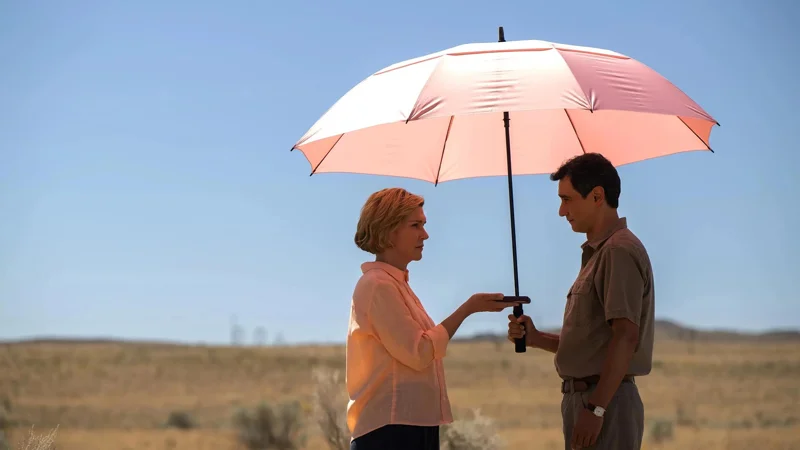 Rhea Seehorn, Carlos-Manuel Vesga on Pluribus
(I understand some criticism that some episodes feel slow, and that Carol's character development doesn't vary enough until the final few episodes. I tend to think of those as strengths, but I digress.)
Initially, I thought that this was due to Gilligan's experience as a storyteller. I knew that he started working on the idea behind Pluribus over a decade ago. Clearly the story and vision was locked in.
Surely the end result was due to his genial story-telling and tremendous, visionary skill...
From One, Many
That's mostly what I thought until I started listening to the official Pluribus podcast which gets incessantly (and annoyingly) promoted before each episode. (It is a great podcast, though.)
What I came to find out is that a large part of the cast and crew has been working together for approximately 20 years, dating back to the start of Breaking Bad.
Not only that, but several of the editors, writers, and directors on this first season of Pluribus are individuals that may have joined the team earlier on as interns/assistants, and have subsequently been given greater responsibilities.
While listening to the different voices on the podcast, which consists of various crew members, it becomes quickly apparent that the success of the show is not because of one singular vision and extreme, personal genius.
Instead, it is because of a cultivated sense of respect between all members of the team.
Many of the podcast guests use terms like "family," "respect," and "welcoming" when describing their experience.
An additional detail that is repeated often is that everyone's input is welcomed, and often times, honored. This stands out, considering that all crew members are also hyper aware of what their role is, and it is usually tied to making someone else's job easier.
Everyone understands their job to perfection and of the value they add to the overall project.
Score
One aspect that I found absolutely fascinating was the podcast episode with composer Dave Porter (episode 5).
He has been working with Gilligan since the start of Breaking Bad and has written the original music for all his subsequent projects (Better Call Saul, El Camino, Pluribus).
Porter was asked a question about his process, particularly in terms of how he figures out a time signature that coincides with emotional beats, as well as visual cues in a pre-existing scene.
I love his response. He talks about the "gift of time" which is something that is planned for and fostered in Gilligan sets (others talk about this as well).
But this particular quote floored me. Forgive the long quote:
The truth is, these scenes have an inherent rhythm to them, always. It starts with you guys. It starts with the writing, it starts with the script... there are so many decisions that get made down the line that have tempo inherent in them. The performances. How you guys shoot it and block it. And definitely how its cut. ... there's an innate timing that goes into it.
He goes on to mention how he doesn't start compositions with any instrument. He starts with just a metronome, the simplest of tools. His goal is to find the inherent tempo of a scene.
He continues:
And I've worked with this group long enough that I know your tendencies too, and I know what numbers in my head, like where to start, because I have a sense of how you guys work. But for me the art of film scoring differs from the art of making music in general in that it should be and is most powerful when it is most tailored to everything else. The picture. And the performances. And all the rest of it.
This only drives the point home which I started to realize as I've been listening to these podcasts.
Genius
The genius to the show is not singular.
It is through a combination of mutual respect, understanding, expertise, humility, and experience.
This point is further calcified in a later bonus episode (7th bonus episode) with Paul Donachie, director of photography.
It is quickly apparent that his expertise is nearly unmatched. His ability to understand the way a scene might need to be lit, or at what time of day the sun may provide the best cover is marvelous.
Yet clearly, he understands his role.
When asked about how he approaches his work with newer/novice directors, he says:
My first premise is that you're there to help that director make a film for them. It's their film, they're making it, so you're there just to help them do that, and to do the best you can for them.
Code
I know it's tempting to make metaphorical connections, even when not everything lines up one to one, but I couldn't help but think about how this applies to my work.
I love writing Python for the same reason I loved carrying around a boom pole for my friend two decades ago.
It is a chance to have fun. Be creative. Solve problems. Work with others who have similar interests with overlapping values, but some contradictions as well.
Coding, for me, is more about creating than producing a product.
Not all of us are lucky enough to work in an environment such as Gilligan's set. But maybe it provides us with a guide for what to aspire to.
If you're at an organization who seems intent on devaluing the work of junior engineers, you can bet that these juniors will bail as soon as they can find a better offer, that's if they exist at all (both the junior devs or the better offers).
Developing an effective team will be much harder when you're working with individuals who are more interested in what they produce than what they create.
Everyone has an inherent rhythm.
If you begin to relegate tasks that are specific to building a product—from building tests, infrastructure, prototypes, refactoring, optimizations, and so on—you're depriving others from being part of a team that understands each other and their roles.
Again, I'm not trying to say that an engineering team should operate similar to a veteran television set.
But I'm also not not saying that.